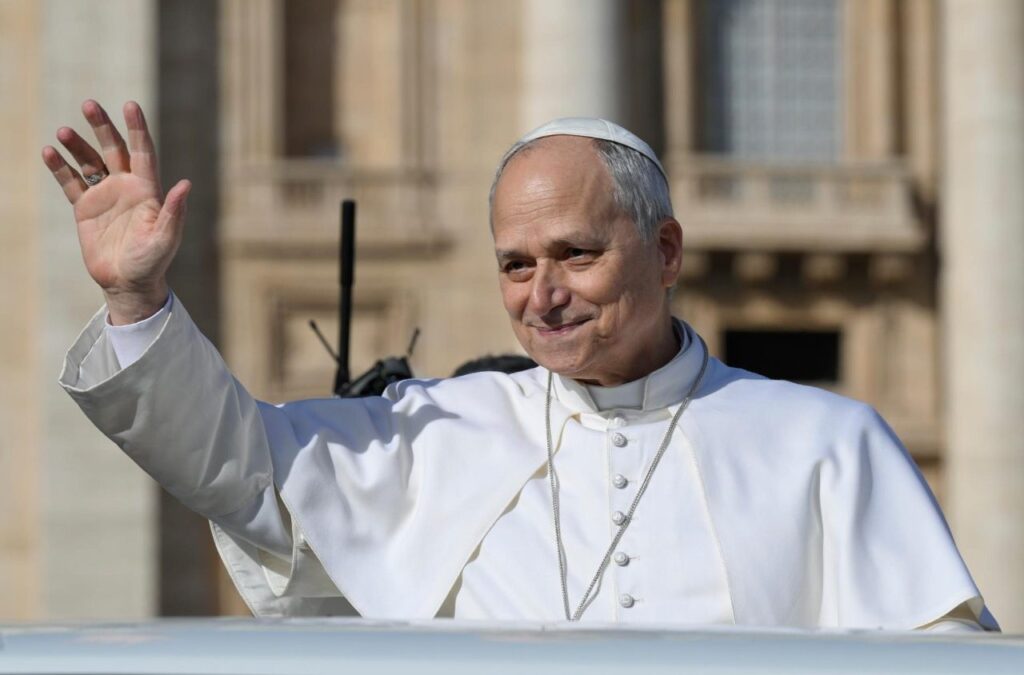
In the first year of his pontificate, Pope Leo is quietly transforming the Church through a transformation of the papacy itself. His recent Apostolic Visit to Africa offered him the stage to bring together, in an illuminating and effective way, the priorities of his papacy. The practical manifesto of the Leonine papacy as a courageous pursuit of peace, healing for a divided world and a divided Church, reverence for the Church’s traditions, and love for those at the existential peripheries of life was on full display during his trip to Africa.
Africa became the stage upon which Pope Leo revealed his understanding of the papacy’s role today and his effective use of the papal pulpit for proclaiming a prophetic theology: a battle cry for the recovery of a moral vision and a social ethic of care, recognition, reconciliation, and community; a spiritual proclamation in a fractured world yearning for moral clarity, justice, solidarity, and hope. His African visit presents five defining messages that together form a coherent vision of Pope Leo’s leadership style, pastoral agenda, and clear articulation and embodiment of the global mission of the Church amid the complexities of our time.
The Five Messages from Africa: A Practical Manifesto
Pope Leo, in his reflection during the first General Audience after his visit to Africa, spoke first of listening to Africa. He noted that his visit helped to make “the voices of Africa heard,” even as the continent offered him “an inestimable treasure” for his heart and ministry. This mutual exchange reflects his agenda for a synodal Church that listens before it speaks, a Church that receives before it gives. It points to his determination to expand the spaces for dialogue and encounter in the Catholic Church for all people, and to place Africa at the center of his papacy, rather than at the peripheries where it is often confined in global politics and ecclesial imagination.
In this, one hears a direct echo of Gaudium et Spes, which calls the Church to read the signs of the times not from above history, but from within it, attentive to the joys and sorrows of the people of God, especially the poor and the forgotten. Pope Leo signals, in his first major teaching, Dilexi Te, that the plight of the poor should be at the center of the Church’s mission. He warns against revictimizing the poor by blaming them for their own misfortune and suffering and instead insists that society must confront the structural causes of poverty. For him, the beginning of justice is listening to people experiencing poverty and walking with them in solidarity, recognizing their agency rather than dismissing them as burdens. Second, the Pope’s journey to Africa was marked by an unmistakable commitment to peace in a fractured world.
This has been his signature papal message. Vatican News reports that, in the first year of his papacy, Leo has used the word ‘peace’ more than 400 times in his speeches. He described his visit to Africa as a proclamation “of peace at a time in history marked by wars and serious and frequent violations of international law.” In Africa, as in many parts of the world, violence has become commonplace and relates not only to war, conflicts, and civil strife, but also to structural, economic, and political violence.
“Pope Leo’s insistence on peace situates his papacy within the Church’s mission of proclaiming the peace of the Lord Jesus Christ to all men and women of goodwill, as well as within a broader call to renew international co-operation and global solidarity at a time when both are under severe strain.?”
Third, Pope Leo highlighted what he called the joyful faith and resilient hope of African peoples. Even amid hardship, he encountered communities whose faith is not diminished by suffering but deepened through it. But he notes in both Angola and Equatorial Guinea that this faith should not be manipulative through superstitious beliefs and other forms of religious enchantment. On the contrary, faith in the Lord, embracing the Gospel message, and entry into the Church should be a resource for healing, liberating people, and promoting human flourishing.
Everywhere he went during his pilgrimage, he affirmed the dignity, resilience, joy, and hope of Africans. In his vision, people experiencing poverty are not objects of compassion, nor should they be condemned and abandoned as the authors of their own misfortune. They are subjects of history. For a world increasingly marked by despair, Africa becomes not a problem to be solved but a witness to be received and a treasure to be harvested for the good of its peoples.
“Faith, for Pope Leo, is a principle of joy, but that joy must be grounded in both a person’s encounter with the Lord in the intimacy of the heart and the experience of abundant life in just communities ordered by love and actively promoting the common good for all. ”
Fourth, the Pope spoke candidly of Africa as a land “thirsting and hungry for justice and peace.” Yet he was equally clear that these cannot be realized without concrete political and economic reform and transformation. Love, in his vision, must become a force for social restoration. Here, his Augustinian roots are evident, as in Augustine, God is closer to the human person than we are to ourselves. Thus, social or ecclesial transformation must begin with the inner transformation of the heart from all forms of idolatry and power to dominate, and from an exaggerated love of the self to the forgetfulness of God and others.
The same is also true of peace. Peace must be unarmed and begins with disarming the heart and our words because peace proceeds from “an interior movement” and then flows outward. Pope Leo called for good governance and a collective commitment to “promoting integral and sustainable development,” while urging the global community to counter “the various forms of neo-colonialism with far-sighted international cooperation.” He moves beyond vague appeals and names the structural conditions that perpetuate inequality. His vision is not only moral. It is institutional.
Fifth, and perhaps most revealingly, Pope Leo returned to the central message of his papacy, first articulated when he appeared on the loggia after his election: the mission of building bridges in a divided world. This is the full meaning of the term Pontifex, used to address Popes from the 4th century, especially with Pope Leo I. The call for a world that builds bridges of respect, friendship, and love among all religions, races, and peoples was a frequent refrain in his speeches in Africa. In doing this, he invited Africans and the world to reimagine political and social life from the standpoint of those most affected by division and conflict in order to heal a fractured humanity.
What is in a Name: From Pope Leo XIII to Pope Leo XIV As Pope Leo XIV marks one year in office, it becomes increasingly clear that his choice of the name Leo was prescient because he seems to have read the signs of our times correctly. It was a deliberate prophetic and pastoral gesture, signaling his intention to stand in continuity with Pope Leo XIII.
“History suggests that in moments of deep social, political, and economic crisis, the human family often instinctively turns to moral and spiritual authorities such as the Church for clarity, guidance, stability, and hope.”
In the latter part of the nineteenth century, Pope Leo XIII confronted a world unsettled by war, industrial upheaval, rising nationalism, the exploitation of workers, authoritarian political formations and leaders in Europe, and a growing erosion of moral consensus. His response was to call the Church to a renewal of its social teaching, holiness of life, wisdom traditions with an organic intellectual depth and synthesis, and pastoral courage, most notably in Rerum Novarum, the so-called worker’s charter, which offered a framework that engaged modernity through the rich treasures of the Gospel.
By invoking this legacy, Pope Leo XIV signals a lucid awareness that our present age bears striking analogies to that earlier moment. The forms, sites, and dramatis personae have changed, but the gravity remains. Today, the world faces an epidemic of war and violence, resurgent autocratic tendencies, widening economic inequality, new and subtle forms of colonial domination, racism against black people, and a fragile, exhausted, and often fractured international order. In choosing the name Leo, he situates his papacy within a tradition that reads the signs of the times with sobriety, while proposing the enduring resources of faith, reason, holiness of life, unity of doctrine, and Catholic social teaching as pathways toward a more just and humane world.
What Next for the Church in Africa and Beyond?
Africa became the launching pad for Pope Leo’s message, but the question remains whether that vision can be translated into concrete action. To follow Pope Leo’s lead requires a deeper ecclesial conversion in Africa. It requires a shift from silence to prophetic witness. When Pope Leo calls for breaking the “chains of corruption,” he is calling Church leaders to confront systems of injustice. Silence in such contexts is not neutrality; it is complicity. The Church must also move from charity to justice by addressing the structures that sustain poverty and by becoming a Church of the poor, with the poor, and for the poor.
“Pope Leo is also inviting the Church to move from clerical control to synodal co-responsibility, and from self-preservation to accountability in public life. Lay people, women, and young people must actively shape the Church’s mission.”
The Church in Africa must listen to the cry of suffering people and the wounded earth. It must move from theological abstraction to a lived and prophetic public theology that speaks truth to power and engages governance, economics, and social life. It must also shift from dependency to an asset-based Church rooted in African resources, cultures, and spiritual traditions.
As Pope Leo enters the second year of his pontificate, many challenges lie ahead. He must display the same courage shown in confronting political failures and moral bankruptcy in his country of birth by also challenging Church leaders to model accountable, transparent, and inclusive leadership. He must continue implementing the proposals emerging from the 14 Study groups of the Synod on Synodality and deepen the reform of the Roman Curia through greater collaboration, professionalism, transparency, inter-dicasterial cohesion, monitoring, and performance evaluation.
“Yet the transformation of the Church ultimately belongs to all God’s people.”
In Pope Leo, however, we already see signs of a listening pope who respects the traditions of the Church, stands for the truth of the Gospel, and understands the urgency of the present moment. Church leaders in Africa and elsewhere have much to learn from his quiet transformation of the papacy.