
Category

Echoes from the Sacred Forest

Echoes from the Sacred Forest

The Ancestors Accept Libation – Even in Foreign Lands

Even before I knew the word libation, I had already understood its language of silence. In the early mornings, my elder sister and I would sit beside our grandfather, watching him pray to the Creator and pour a libation to our ancestors. I was too young to understand the words he spoke, but my body remembers his gestures, his face and the reverence with which he entered into communion with the Creator, the ancestors and all our human and more-than-human relations. We followed every movement as his ageing hand raised the kola nut and poured the liquid, one offering after another. He died when I was three, yet the memory of those morning ceremonies remained inscribed within me. For many years, I thought the ceremony had disappeared from my life; that I am now far away from the sacred world of my earliest years. Then, on the traditional and unceded territory of the Algonquin Anishinaabeg Nation, an Effutu king from Ghana, Neenyi Ghartey VII, poured libation again, nudging the child still within me to remember. The ancestral ceremony returned to me in a land where the language of libation required more than translation. Many African Christians of my generation, and younger generations, were taught to regard libation as incompatible with Christianity. We were taught to see it as worship of the dead, superstition or even evidence of an unconverted past. We were repeatedly told that it was a pagan practice—a past to be exorcised. Yet such hasty judgments about the cultural and spiritual practices of Indigenous peoples were often instilled in missionaries before they ever encountered the peoples and lands they had been sent to serve. They therefore seldom listened carefully enough to grasp the ethical and religious meanings of the ceremonies they encountered. For generations, missionaries often saw only liquid being poured upon the earth. Even those of us who later became missionaries have sometimes perpetuated that narrative. We continue to see the gesture without appreciating the relationships it renews, gratitude to the Creator, remembrance of the ancestors, communion with the land and commitment among the living. This text does neither argue for an indiscriminate incorporation of ancestral ceremonies into Christian worship, nor try to romanticize all ancestral ceremonies. When a ceremony is absorbed into Christian categories without respect for its own integrity, such incorporation risks becoming another form of assimilation rather than genuine inculturation. Certainly, the Christian reception of ancestral traditions requires discernment, but discernment cannot begin with disrespect. A Church that calls itself catholic can neither neglect Africa’s sacred memory nor dismiss its spiritual treasures as superstition. It must first listen, enter into relationship and seek to understand the ethical and spiritual meanings these traditions carry. Today, I wonder whether we have listened carefully enough for the echoes of libation in Scripture. The Hebrew Scriptures contain numerous accounts of drink offerings. At Bethel, Jacob pours a drink offering and oil upon the pillar where God had spoken to him (Genesis 35:14). The Law of Moses also prescribes drink offerings to accompany other sacrifices (Numbers 15:1–10). Paul later draws upon this ancient ritual vocabulary to interpret his own life: “I am already being poured out as a libation, and the time of my departure has come” (2 Timothy 4:6). In Philippians 2:17, he similarly imagines himself being poured out upon the sacrificial offering of the community’s faith. Although Paul does not reproduce libation as a Christian ceremony, he draws upon its spiritual grammar. In doing so, he presents the faithful life as a libation—a life poured out in love so that others might live. The biblical understanding of libation and African ancestral practices should not be compared, for they arise from distinct histories and spiritual worlds. Nevertheless, their shared common language of offering, communion and self-giving allows them to shed light to one another. The significance of libation in the imagination of Black communities also extends beyond the shores of the motherland. In many Kwanzaa observances, libation is poured, often using the kikombe cha umoja, or unity cup, to honour the ancestors and reaffirm the bonds uniting the living. The Middle Passage, enslavement and dispersal fractured communities, but they could not entirely erase this ancestral memory. Across generations, Black communities continued to renew relationships among the divine, the ancestors, the living and the more-than-human world. I came to understand this anew through Neenyi Ghartey VII, the Paramount Chief of the Effutu Traditional Area and traditional ruler of Winneba, Ghana. Although he had come to Ottawa to meet members of the Ghanaian community, the ancestors seemed to open another path for his visit: a conversation about traditional approaches to conflict resolution with Elders at the Indigenous Centre. At the beginning of that conversation, he called upon the Creator and the ancestors to accompany the journey upon which our different peoples were embarking. That day in the Indigenous Centre at Saint Paul University, an Effutu paramount chief poured libation on an Algonquin territory, and the Igbo child within me recognized the gesture even before the theologian within me could explain it. For me, pouring an African libation on Algonquin territory did not transform that territory into African ground. Instead, it reminded me that the land is never empty. It was already alive with memory, responsibility and relationships, and the ceremony was only calling me to remember my ancestors and to honour the people whose land had received me. Before that encounter, I had often returned to the mornings I spent beside my grandfather, but I never expected to feel so deeply welcomed back to the ancestral circle, and to the maternal embrace of the land of my forefathers. Perhaps the ancestors had neither abandoned me nor withdrawn their gaze. Perhaps I was the one who had wandered beyond the circle, lost in a territory far away from the rivers that for centuries quenched the thirst of our people. Years of philosophical and theological formation may have deafened my ears to the call of our ceremonies or trained my ears

The Ancestors Accept Libation – Even in Foreign Lands Read More »
When the Sacred Becomes a Playground

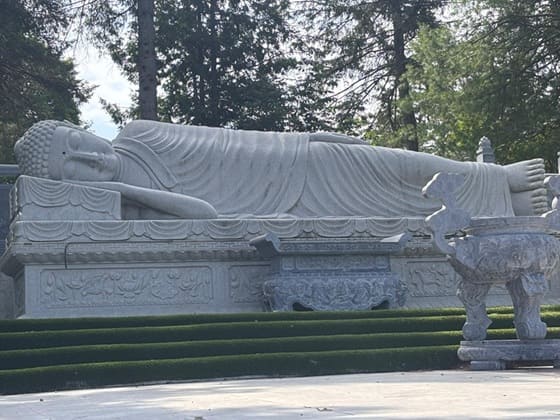
A few weeks ago, after hours of study, I stepped out for a walk around our cottage on a beautiful morning. The path led me to a nearby Buddhist monastery in Val-des-Monts, Quebec. At its entrance stood statues of the Buddha and bodhisattvas. While I contemplated the beauty of this sacred garden, an idea slowly crept into my mind: every religious tradition bears testimony to the sacred in its own distinctive way. A visit to a temple, church, synagogue or shrine reveals how each tradition interprets the manifestation of the divine. Yet no single tradition exhausts the depths of the religious experience of entire humanity. Sometimes, we must cross over to another milieu and stand before the sacred images of another tradition to recognize something that has always been present, though perhaps neglected, within our own. Among the statues scattered across the monastery grounds in Val-des-Monts, two held my attention. One showed the reclining Buddha resting peacefully at the end of his earthly life. The other depicted a large-bellied, laughing figure surrounded by children. At first, the two scenes seemed to contradict each other, for while one was still and solemn, the other was noisy and playful. One suggested a sacredness capable of receiving life’s ending; the other, a sacredness open to its noise, movement and new beginnings. The reclining figure appears to represent Śākyamuni—Siddhartha Gautama, the historical Buddha—approaching parinirvana. He lies peacefully on his right side, his hand gently supporting his head. His face is composed, almost meditative. His elongated body is relaxed, and his robes fall quietly around him. There is no visible struggle; his robe is not ruffled, and there is no sign of fear in his face. In Buddhism, parinirvana is not simply death, nor is it a passage from this world into another in the Christian sense of resurrection. It is the final nirvana of one who has already attained enlightenment: complete liberation from attachment, suffering and the continuing cycle of death and rebirth. Then there was the other curious statue. It was the smiling, large-bellied statue of Budai, the cheerful Chinese monk popularly known as the Laughing Buddha and later associated with Maitreya, the Buddha of the future. Historically, Budai and Maitreya were not originally the same figure. Over time, however, Budai, a tenth-century Chinese Chan monk, came to be regarded as a manifestation of Maitreya, the bodhisattva expected to become the Buddha of a future age, when the Dharma has faded and must be renewed. But what drew my attention was neither his large belly nor his enormous smile, but the children. They climbed all over him, with some sitting on his shoulders, while others touched his belly, leaned against him, or pulled at the objects in his hands. Yet he neither pushed them away nor appeared disturbed by their noise. This holy figure had allowed himself to become their playground. What an image! \” This holy figure had allowed himself to become their playground” — Fr. Nnaemeka C. Ali, O.M.I. For a long time, many outsiders have imagined Buddhism simply as a religion of silent meditation, withdrawn monks, and detachment from the world. Yet this image suggests something more: holiness is not necessarily an escape from life. It can also mean being fully present within it—welcoming, accessible, and capable of laughter. Budai—associated in the Buddhist imagination with the future Buddha—is surrounded not by rulers, religious dignitaries, or guardians of orthodoxy, but by children. Perhaps that is where the future begins. As I continued contemplating the scene of children climbing over Budai, I remembered a story about Saint Francis of Assisi. Francis was preparing to pray and reportedly instructed his brothers not to interrupt him, no matter who came—a king, a ruler, or anyone else. Then, after a second thought, he reportedly added that if a child came, the brothers should let him know. Whether or not the story can be traced directly to Francis, it expresses something profoundly Franciscan: no prayer that closes its ears to life can claim to bring us closer to the God of life. It also resonates with the Gospel. In the Gospel of Mark, with parallels in Matthew and Luke, people bring children to Jesus so that he might touch them. The disciples rebuke them, perhaps thinking that the children are disturbing him. But Jesus becomes indignant. “Let the little children come to me; do not stop them,” he told the disciples. Then he took them into his arms, laid his hands upon them, and blessed them (Mark 10:13–16; see also Matthew 19:13–15 and Luke 18:15–17). He went even further: “Whoever does not receive the kingdom of God as a little child will never enter it.” For him, a child was no longer simply someone to be admitted into sacred space. The child became the teacher through whom adults must learn how to enter it. \” The child was no longer simply someone to be admitted into sacred space. The child became the teacher through whom adults must learn how to enter it” — Fr. Nnaemeka C. Ali, O.M.I. The scene is remarkably close to what I encountered in Val-des-Monts: two different traditions—Budai, traditionally associated with Maitreya, surrounded by children, and Jesus taking children into his arms—yet one unsettling question: What kind of holiness are we building if children are afraid to approach it? As I admired the serenity of the garden, I pictured an evening that could unfold in many African communities. It might be under a tree, in a family courtyard, beside a church or around an evening fire. Adults talk while children play freely around them. A mother prepares food. A grandfather tells stories of earlier generations. Some children gather close to listen; others, too restless to remain in one place, continue their games. Yet even those who appear distracted are listening. Through stories, gestures, laughter and silence, they learn the relationships and memories through which the community understands itself. The details differ from one African culture to another, but the sacred is

When the Sacred Becomes a Playground Read More »

Nigeria’s Christian Crisis: Silence in Abuja, Strategy in Washington

It was an ordinary Sunday for many on February 22. However, for the residents of Edikwu G’Icho, Ole-G’ijamu, and Ukpogo in the Apa Local Government Area of Benue State, it was anything but. The residents started their day as usual, unaware that it would be their final day on earth. Unannounced, herders invaded and ransacked their villages, resulting in the death of a pastor returning from church and another individual, and the alleged sexual assault of two additional women. They were victims of the senseless routine killings that have become the sad reality of Nigeria’s national life in the last decade or so. Many Christian communities across Nigeria now live in constant fear of kidnappers and armed groups. From the North West through the North East, into the Middle Belt and parts of the South, armed militias, insurgents, and criminal bandits have terrorized villages with alarming frequency — a situation that prompted the United States government to designate Nigeria as a Country of Particular Concern (CPC). The problem, however, is that since Nigeria was designated a Country of Particular Concern, the situation for Nigerian Christians has not improved. Despite diplomatic visits from Washington and even a Christmas Day strike by the U.S. military, despite the arrival of some U.S. military personnel, the killings continue. Villages are still attacked. Clergy are still abducted. Families are still displaced. “Since Nigeria was designated a Country of Particular Concern, the situation for Nigerian Christians has not improved.” — Nnaemeka Ali, O.M.I. This has raised a troubling question for many Nigerians: whose interests are truly served by the dialogue between Washington and Abuja? When U.S. President Donald Trump announced sanctions against the government of Bola Ahmed Tinubu on Truth Social in October 2025, Nigerians were divided. Some celebrated the move as a long-overdue protection for persecuted Christians. Others questioned whether Washington was genuinely concerned about the suffering of Nigerians or merely advancing a strategic agenda. Many suspected that behind the strong language lay carefully concealed diplomatic calculations for regional political control. “Christianity is facing an existential threat in Nigeria,” Mr. Trump declared. “Thousands of Christians are being killed. Radical Islamists are responsible for this mass slaughter. I am hereby making Nigeria a ‘Country of Particular Concern.’” Yet when the U.S. Africa Command (AFRICOM) launched a strike against ISIS-linked targets in Sokoto — a move described as a Christmas gift to Nigerians — questions emerged. Why Sokoto? Why then? And why did the attacks on vulnerable Christian villages continue almost uninterrupted? In the months that followed, American delegations visited Nigeria. Nigerian religious leaders travelled to Washington to testify about the horrors their communities endured. On February 16, 100 U.S. soldiers arrived in Nigeria, with 200 more expected later. Although it may be too early to assess the outcome of this deployment, past cooperation between Nigeria and the United States against Boko Haram produced no visible results; in fact, Boko Haram grew stronger over the years. Moreover, the terms of this recent partnership remain nebulous. There has been no transparency about the negotiations, no meaningful dialogue with Nigeria’s governing institutions to reassure citizens that this arrangement truly serves their interests. Despite the increased military presence and diplomatic exchanges, the death toll has not declined significantly. The bandits persist in their raids, kidnappings continue, and communities remain exposed. Meanwhile, policymakers in the United States formed a commission. They took their time to study the situation thoroughly. They listened to victims and spent hours online, presenting themselves as defenders of the persecuted in Nigeria. And because they know we are a deeply religious people, they presented themselves as acting in defense of Christian communities. Then, on February 23, 2026, after reviewing submissions and testimony, the U.S. House Appropriations Committee and the House Foreign Affairs Committee issued a joint report on the persecution of Christians in Nigeria. The report opened with a forceful declaration, stating that “Nigeria is the deadliest place in the world to be a Christian.” It detailed violent attacks by armed militias and terrorist groups, the killing of pastors and priests, the destruction of churches and schools, and widespread kidnappings. At first glance, the report appears to stand firmly with Nigerian Christians. It proposes a bilateral agreement to protect vulnerable Christian communities and urges the Nigerian government to deploy sufficient security forces to the Middle Belt and other affected regions. It demands that militias be removed from confiscated farmland and that displaced communities be allowed to return home voluntarily. The report also addressed religious freedom, calling for sanctions against groups and individuals who participate in or tolerate violence against Christians, and even raising the question of Sharia law in some states. However, a closer reading reveals something more. Very quickly, the crisis of Nigerian Christians is reframed as a matter of U.S. homeland security. The report calls for comprehensive counterterrorism cooperation to eliminate Foreign Terrorist Organizations that pose a direct threat to the American homeland. It goes further, urging Nigeria to reduce its military dependence on Russia and deepen defence procurement ties with the United States. It also calls for countering Chinese and Russian influence in Nigeria. “Very quickly, the crisis of Nigerian Christians is reframed as a matter of U.S. homeland security.” — Nnaemeka Ali, O.M.I. In addition, the report recommends that the U.S. Treasury Department strengthen oversight of Nigeria’s financial system to safeguard U.S. national security and enhance America’s favourable trade balance. While discouraging Nigeria from collaborating with China and Russia, the report advises Abuja to seek support from France, Hungary, and the United Kingdom. At this point, the humanitarian tragedy of Nigerian Christians appears intertwined with broader geopolitical objectives. And while these negotiations unfold, Nigerian Christians continue to die. Many Nigerians once hoped that international pressure would bring relief. But the emerging pattern suggests that foreign involvement may be driven as much by strategic calculations for economic and regional political control. Yet to this day, nothing has changed. Christians keep dying in their villages under Abuja’s watch and amid Washington’s geopolitical ambitions. And

Nigeria’s Christian Crisis: Silence in Abuja, Strategy in Washington Read More »

Secret Link