Pan-African Catholic Theology and Pastoral Network

Strait of Hormuz

Rising Oil Prices: What Is Nigeria Doing with Its Petro-Dollar Windfall?

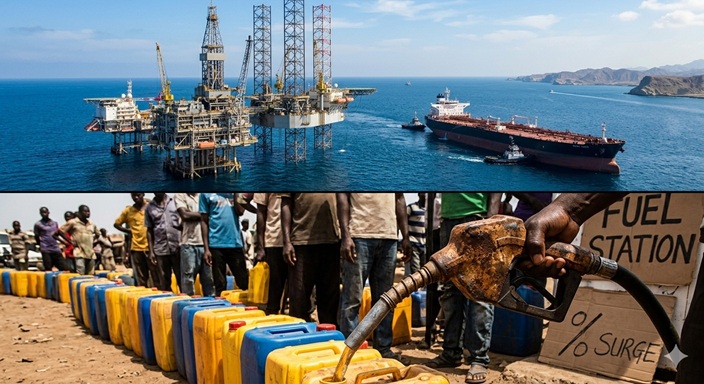
As global oil prices rose following tensions around the Strait of Hormuz, many Nigerians expected relief at the fuel pump. Instead, prices surged. Fuel prices have skyrocketed by 39.5%, plunging Nigeria into yet another fuel crisis. Located between Oman and Iran, the Strait of Hormuz is considered one of the most critical oil chokepoints in the world, with an estimated 20% to 25% of global oil transiting the strait—roughly one out of every five barrels. Its strategic importance is already causing ripple effects across global markets. Overall, Asia receives about 90% of the oil passing through the Strait of Hormuz, with countries such as China, Japan, India, and South Korea receiving a significant share and already feeling the impact. Nigeria is one of the countries benefiting from rising oil prices. But why is Nigeria caught in the dilemma of earning more from crude exports while facing higher fuel prices at the pump Nigerian Fuel Crisis: More Dollars from Crude Export, High Fuel Prices and Rising Economic Hardship The Nigerian fuel crisis may appear complex, but it is driven by several structural problems working together. The removal of fuel subsidies ushered in the current energy challenge. For decades, Nigeria kept petrol prices artificially low through subsidies, where the government absorbed part of the cost. Since this was removed in 2023, consumers now bear the full cost and directly feel the impact. “Nigeria earns more from oil, yet Nigerians pay more for fuel.” — Augustine Anwuchie This has placed significant strain on a petroleum-dependent economy that failed to diversify over the years. Crude oil accounts for an estimated 80–90% of Nigeria’s foreign exchange earnings and about 30–40% of federal government revenue. This makes the economy highly vulnerable to oil shocks, compounded by weak local refining capacity, a fragile exchange rate, and inflationary pressures. Even when global fuel prices remain stable, domestic prices continue to rise due to currency depreciation. Fuel imports are priced in dollars, and a weaker naira means higher costs in local currency. While it is often assumed that higher crude oil prices should benefit Nigeria and lower fuel costs, petrol pricing depends on multiple factors—refining, transportation, exchange rates, and market deregulation. Since government withdrawal from subsidy regimes, private marketers now dominate fuel importation and distribution. Their pricing is determined by landing costs, exchange rates, and profit margins, resulting in frequent price fluctuations. Logistics and distribution challenges—poor pipeline infrastructure, reliance on trucking, and supply bottlenecks—continue to undermine price stability. Low production has also compounded the problem, costing Nigeria over ₦28 trillion in oil revenue despite the boom. Although the Dangote refinery is expected to reduce import dependence, it is still ramping up operations, and its pricing remains tied to global market dynamics. Relief, therefore, may be gradual rather than immediate. The refinery has also faced regulatory tensions with the Nigerian Midstream and Downstream Regulatory Authority (NMDPRA) over import licensing, while disputes with the Petroleum and Natural Gas Senior Staff Association of Nigeria (PENGASSAN) have further complicated operations. “The crisis is not a lack of oil—it is a failure of structure and coordination.” — Augustine Anwuchie In essence, fuel remains expensive in Nigeria not because of crude scarcity, but due to subsidy removal, heavy import dependence, a weakened naira, limited refining capacity, and a weak regulatory framework. A Crisis Compounded by Corruption and Waste The pressing question for many Nigerians remains: if subsidy payments have ended, where are the savings? The government maintains that these funds are being redirected toward stabilising the economy, financing infrastructure, supporting social programmes, and cushioning energy costs. In theory, such funds could improve salaries, infrastructure, healthcare, education, power supply, and industrial development. However, many Nigerians report seeing little tangible impact. Civil society organisations such as SERAP have alleged that significant portions of these funds remain unaccounted for, raising concerns about transparency and accountability. At the same time, some analysts argue that the savings may not be sufficient to drive transformative economic change at scale. A Hope Wrapped in a Fragile Thread Nigeria has experienced oil windfalls before, notably during the 1973 oil boom. However, the long-term effects of that period—often described as “Dutch disease”—continue to shape the present, reflecting missed opportunities for diversification and sustainable economic planning. Today, many Nigerians face rising economic hardship, insecurity, and governance challenges. “Without reform, oil wealth will continue to deepen hardship rather than resolve it.” — Augustine Anwuchie Breaking this cycle requires decisive action. Nigeria must invest in diversification—particularly in agriculture, manufacturing, and technology—while strengthening transparency and accountability in managing public resources. Short-term relief must also translate into tangible improvements in living conditions. Without such reforms, Nigeria risks remaining trapped in a cycle where resource wealth fails to translate into broad-based prosperity.

Rising Oil Prices: What Is Nigeria Doing with Its Petro-Dollar Windfall? Read More »
The U.S. and Israel are Fighting an Unjust War in Iran

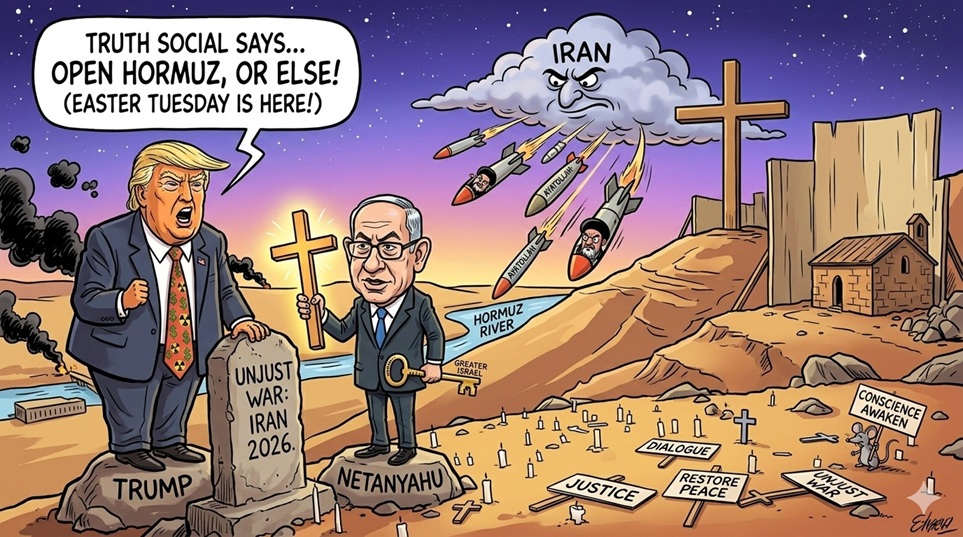
Reading the recent threats issued on Truth Social by President Trump on Easter Sunday, and his public statements on Easter Monday, threats to completely destroy Iran by Easter Tuesday, to blow up bridges, to dismantle power plants, if the Strait of Hormuz is not opened by Iran, were not only disturbing; they were heartbreaking. It forces one to ask, with a heavy conscience: how did America and the rest of the world arrive at such a perilous moral moment, where the language of annihilation is normalized and even baptized using Christian categories and language as a strategy? President Trump’s threats are not a sign of strength. Rather, it shows some sign of desperation, impatience, incohesion that has characterized his justification of this war from the beginning of this unfortunate war, and a lack of any prudence or sound judgment. This is a dangerous abandonment of the ethical restraints that govern the conduct of war and preserve our common humanity and could constitute a war crime and a violation of the U.S military’s rules of engagement. “When the language of power abandons justice, it becomes recklessness dressed as authority” — Stan Chu Ilo We may call it negotiation. We may call it deterrence. But when the language of power abandons the discipline of justice, it becomes recklessness dressed in the garments of authority. It becomes, in truth, a grave moral failure. What we are witnessing today is deeply troubling. The current war started by the United States and Israel against Iran does not, in my judgment, meet the conditions of a just war and is thus an unjust war. It lacks moral clarity, proportionality, and credible evidence of imminent threat. Preventive war, dressed up as necessity, remains ethically indefensible in international law. It is even more ethically flawed when it is driven by fear, speculation, or geopolitical ambition and economic interest rather than demonstrable and imminent danger. The unnecessary loss of innocent lives cannot be reduced to a strategy or collateral damage, particularly since this is an unjust war. The life of an American soldier is as sacred as the life of an Iranian child. The tears of a Palestinian mother, the grief of an Israeli father, the anguish of a Lebanese family, these are not inevitable collateral realities. They are the very measure by which history will judge us. And what shall we say about the systematic destruction of civilian infrastructure? Of universities, hospitals, power systems, and bridges reduced to rubble? What shall we say of targeted assassinations that erode every moral boundary? These are not signs of justice or strength but acts of cowardice driven by fear. These are wounds inflicted upon the fragile body of our shared humanity. “The Cross reveals sacrificial love, not domination; the Resurrection proclaims life, not destruction.” — Stan Chu Ilo One day, a future generation, perhaps wiser, perhaps more humane, will look back upon this moment in 2026 and ask: how did reasonable people remain silent while an architecture of violence was constructed before their very eyes? How did nations, endowed with reason and conscience, allow themselves to be carried by the winds of fear, power, and vengeance? They will ask how leaders, intoxicated by power, mistook domination for security, and destruction for peace. As a Christian leader, I must speak with prophetic clarity and humility. The Gospel does not bless war. It does not sanctify vengeance. It does not anoint the language of annihilation. As Pope Leo XIV reminded the Church on Palm Sunday, “God does not walk with those who sow death, but with those who build peace with patient hands.” And again, he teaches us: “The Church has no enemies to destroy, only brothers and sisters to embrace.” This message has landed on deaf ears and hardened hearts because the dramatis personae in this ongoing conflagration have a different agenda, which sadly they have not articulated, particularly Trump. I guess for President Netanyahu, it will serve his political interest and desire for a Greater Israel if Iran becomes a failed state and is reduced to rubble by the U.S., repeating what Israel did in Gaza, and then setting up a Board of Peace after the destruction. Let’s pray that this does not happen. This is the scandal of our time that the name of God is invoked in the service of violence, that the Cross of Christ is misappropriated to justify the machinery of war. To compare acts of military power to the death and resurrection of Jesus Christ as the U.S. Defense secretary does repeatedly is not only theologically misguided but a form of idolatry; it is a profound distortion of the Christian mystery. The Cross reveals sacrificial love, not domination. The Resurrection proclaims life, not destruction. As Christians, we must reclaim the robe of righteousness from those who would stain it with the language of war. We must remind the world that Christianity stands on the side of life, dignity, justice, dialogue, and peace. The God of life and the God of Jesus Christ, who came to give us life in abundance, is not the patron of war and vengeful people or nations, but the source of reconciliation. Therefore, the world must not remain silent. Conscience must awaken. Religious leaders, especially those who claim proximity to power, must speak truth, not flattery, as was the case last week when the Religious Freedom Committee met with President Trump at the White House. They must preach restraint, not aggression; humility, not hubris; dialogue, not destruction. They must call leaders to conversion, not reinforce their illusions of invincibility and the superpower syndrome, which largely drives the President. May we be reminded that peace is not weakness.  Peace is the highest expression of moral courage and the greatest longing of human beings. Dialogue is not futile; it is the best expression of our human capacity to reason together and walk towards the promotion of our common good. “Peace is not weakness; it is the highest expression of moral courage.” — Stan

The U.S. and Israel are Fighting an Unjust War in Iran Read More »

Far from the battlefield, close to the bill: Africa and the US–Israel–Iran war

One month into escalating tensions between the United States, Israel, and Iran, the conflict is no longer confined to the Middle East. Its effects are already visible across global markets, supply chains, and political systems. Yet far from the battlefield—in Juba, Abuja, Lusaka, Algiers, and Nairobi—a different question is taking shape: what does this crisis mean for Africa? At first glance, the continent appears distant from the missiles and military maneuvers. In reality, it is already feeling the consequences—rising fuel prices, higher shipping costs, strained aid routes, and growing pressure on governments to respond to a crisis not of their making. “Africa may be far from the battlefield, but it is already paying the price.” — Nnaemeka Ali In economies where reliance on imports persists significantly and fiscal capacity is constrained, such shocks are not readily absorbed. It is tempting to assume that Africa’s oil exporters will benefit from higher prices. Therefore, while some may, briefly, experience advantages, the deeper reality for most countries is exposure to risk. External shocks—particularly those transmitted through energy and trade—have historically had disproportionately severe consequences across the continent. What makes this crisis globally significant is not just its location, but what it endangers. The Strait of Hormuz, through which a large portion of the world’s oil and liquefied natural gas is transported, has become a major concern. As tensions around Gulf infrastructure escalate, oil prices have surged sharply, surpassing $100 per barrel and occasionally nearing $115 (Reuters, March 2026). For many African economies, that shift is immediate. Most depend on imported fuel, so higher global prices quickly translate into increased transport costs, rising food prices, and mounting pressure on household incomes. Policymakers across the continent are already warning that this latest oil shock could spread across key sectors and complicate efforts to contain inflation. Governments now face difficult choices. They can absorb part of the shock through subsidies, placing further strain on already tight budgets, or pass the cost on to citizens, risking social tension. The International Monetary Fund (IMF) has repeatedly warned that many African economies are entering this period with high debt and limited fiscal space, leaving them poorly positioned to absorb external shocks. The first impact of this crisis is therefore not ideological, but fiscal. It deepens vulnerability for importers while offering uncertain gains for exporters. “This is not just a war of missiles—it is a war of prices, and Africa is on the frontline of its consequences” — Nnaemeka Ali This divide is already visible. In Nigeria, higher oil prices do not necessarily lead to stability. Despite being Africa’s largest oil producer, the country remains heavily reliant on imported refined fuel. Recent subsidy reforms have made households more directly exposed to price fluctuations, causing global increases to lead to domestic hardship quickly. For net importers, particularly in East Africa, the effects are more immediate. In Kenya, rising fuel prices affect transport, food distribution, and daily living costs. In Nairobi, this distant geopolitical crisis is already becoming a lived economic reality. Geography sharpens the impact. Countries along the Red Sea corridor—Djibouti, Sudan, Somalia, and Egypt—are at increased risk. Egypt, in particular, is vulnerable through the Suez Canal, a vital route for global trade. World Bank analysis indicates that traffic through the Suez Canal and Bab el-Mandeb Strait drops significantly during times of instability, directly affecting global trade and delivery times. This is not only an energy crisis. It is also a crisis of trade routes. As security threats interfere with essential maritime routes, ships are being diverted around the Cape of Good Hope. This detour prolongs travel durations, escalates expenses, and exerts additional pressure on supply chains. The United Nations Conference on Trade and Development has cautioned that these disruptions are already extending shipping distances and escalating costs throughout global trade networks. Africa is not only paying more for fuel; it is also paying for distance. Longer routes lead to higher freight costs, delays in deliveries, and increased pressure on economies that depend heavily on imports. The strain quickly spreads from ports to markets, transport systems, and households. African leaders are beginning to acknowledge these pressures. On March 4, South Africa’s President Cyril Ramaphosa warned that escalating tensions in the Middle East were already “putting strain on the African continent’s supply chains and causing higher energy prices.” The pressure extends into agriculture. Many African countries depend heavily on fertilizer imports routed through the Middle East. Disruptions are driving prices upward, in some cases sharply. For economies already struggling with food security, higher input costs threaten to reduce output and increase food prices. The consequences are especially severe in places like Sudan, where agricultural systems are already under strain and rising costs risk deepening an existing humanitarian crisis. This is where geopolitics becomes personal. In numerous African nations, governments are assessed less by their foreign policy stances than by the expenses associated with fuel, food, and transportation. When these three costs simultaneously escalate, pressure on authorities intensifies rapidly. The International Monetary Fund (IMF) has observed that inflationary shocks in low-income economies frequently precipitate social unrest, especially in contexts where living conditions are already delicate. At this stage, social institutions become essential. In African cities, churches and mosques are more than just places of worship—they serve as support systems. They handle pressure, provide relief, and give purpose to hardship. As economic pressure increases, they often become the first places people turn to. The humanitarian consequences are increasingly apparent. Disruptions to shipping and logistics are decelerating aid deliveries, elevating costs, and complicating operations in regions already characterized by fragility. For communities dependent on prompt assistance, even minor delays can result in severe consequences. The crisis did not give rise to these vulnerabilities; however, it is intensifying them—augmenting budgets, overburdening supply chains, and applying additional pressure on already fragile systems. African governments are responding cautiously. The African Union has called for de-escalation, reflecting a broader preference for stability over alignment. Many states are hesitant to be drawn into geopolitical blocs, even as external pressure

Far from the battlefield, close to the bill: Africa and the US–Israel–Iran war Read More »