Pan-African Catholic Theology and Pastoral Network

April 2026

The U.S. and Israel are Fighting an Unjust War in Iran

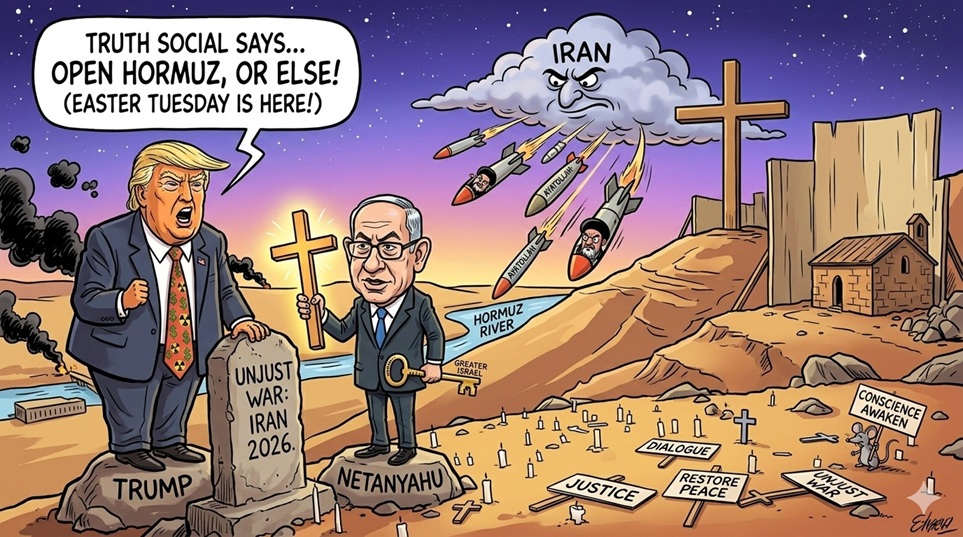
Reading the recent threats issued on Truth Social by President Trump on Easter Sunday, and his public statements on Easter Monday, threats to completely destroy Iran by Easter Tuesday, to blow up bridges, to dismantle power plants, if the Strait of Hormuz is not opened by Iran, were not only disturbing; they were heartbreaking. It forces one to ask, with a heavy conscience: how did America and the rest of the world arrive at such a perilous moral moment, where the language of annihilation is normalized and even baptized using Christian categories and language as a strategy? President Trump’s threats are not a sign of strength. Rather, it shows some sign of desperation, impatience, incohesion that has characterized his justification of this war from the beginning of this unfortunate war, and a lack of any prudence or sound judgment. This is a dangerous abandonment of the ethical restraints that govern the conduct of war and preserve our common humanity and could constitute a war crime and a violation of the U.S military’s rules of engagement. “When the language of power abandons justice, it becomes recklessness dressed as authority” — Stan Chu Ilo We may call it negotiation. We may call it deterrence. But when the language of power abandons the discipline of justice, it becomes recklessness dressed in the garments of authority. It becomes, in truth, a grave moral failure. What we are witnessing today is deeply troubling. The current war started by the United States and Israel against Iran does not, in my judgment, meet the conditions of a just war and is thus an unjust war. It lacks moral clarity, proportionality, and credible evidence of imminent threat. Preventive war, dressed up as necessity, remains ethically indefensible in international law. It is even more ethically flawed when it is driven by fear, speculation, or geopolitical ambition and economic interest rather than demonstrable and imminent danger. The unnecessary loss of innocent lives cannot be reduced to a strategy or collateral damage, particularly since this is an unjust war. The life of an American soldier is as sacred as the life of an Iranian child. The tears of a Palestinian mother, the grief of an Israeli father, the anguish of a Lebanese family, these are not inevitable collateral realities. They are the very measure by which history will judge us. And what shall we say about the systematic destruction of civilian infrastructure? Of universities, hospitals, power systems, and bridges reduced to rubble? What shall we say of targeted assassinations that erode every moral boundary? These are not signs of justice or strength but acts of cowardice driven by fear. These are wounds inflicted upon the fragile body of our shared humanity. “The Cross reveals sacrificial love, not domination; the Resurrection proclaims life, not destruction.” — Stan Chu Ilo One day, a future generation, perhaps wiser, perhaps more humane, will look back upon this moment in 2026 and ask: how did reasonable people remain silent while an architecture of violence was constructed before their very eyes? How did nations, endowed with reason and conscience, allow themselves to be carried by the winds of fear, power, and vengeance? They will ask how leaders, intoxicated by power, mistook domination for security, and destruction for peace. As a Christian leader, I must speak with prophetic clarity and humility. The Gospel does not bless war. It does not sanctify vengeance. It does not anoint the language of annihilation. As Pope Leo XIV reminded the Church on Palm Sunday, “God does not walk with those who sow death, but with those who build peace with patient hands.” And again, he teaches us: “The Church has no enemies to destroy, only brothers and sisters to embrace.” This message has landed on deaf ears and hardened hearts because the dramatis personae in this ongoing conflagration have a different agenda, which sadly they have not articulated, particularly Trump. I guess for President Netanyahu, it will serve his political interest and desire for a Greater Israel if Iran becomes a failed state and is reduced to rubble by the U.S., repeating what Israel did in Gaza, and then setting up a Board of Peace after the destruction. Let’s pray that this does not happen. This is the scandal of our time that the name of God is invoked in the service of violence, that the Cross of Christ is misappropriated to justify the machinery of war. To compare acts of military power to the death and resurrection of Jesus Christ as the U.S. Defense secretary does repeatedly is not only theologically misguided but a form of idolatry; it is a profound distortion of the Christian mystery. The Cross reveals sacrificial love, not domination. The Resurrection proclaims life, not destruction. As Christians, we must reclaim the robe of righteousness from those who would stain it with the language of war. We must remind the world that Christianity stands on the side of life, dignity, justice, dialogue, and peace. The God of life and the God of Jesus Christ, who came to give us life in abundance, is not the patron of war and vengeful people or nations, but the source of reconciliation. Therefore, the world must not remain silent. Conscience must awaken. Religious leaders, especially those who claim proximity to power, must speak truth, not flattery, as was the case last week when the Religious Freedom Committee met with President Trump at the White House. They must preach restraint, not aggression; humility, not hubris; dialogue, not destruction. They must call leaders to conversion, not reinforce their illusions of invincibility and the superpower syndrome, which largely drives the President. May we be reminded that peace is not weakness.  Peace is the highest expression of moral courage and the greatest longing of human beings. Dialogue is not futile; it is the best expression of our human capacity to reason together and walk towards the promotion of our common good. “Peace is not weakness; it is the highest expression of moral courage.” — Stan

The U.S. and Israel are Fighting an Unjust War in Iran Read More »

Easter’s Joyful Hope Is Not Sentimental

As Christians across Africa join the global Church in celebrating Easter, they await the season’s ancient message of joyful hope with urgent expectancy. Many individuals and communities enter the Holy Week carrying the weight of sin, frustration, economic strain, political uncertainty, and social fragmentation. Yet it is precisely into this landscape that Easter’s central proclamation, that life, not death, has the final word, continues to resonate with force and bold proclamation. Every year, Easter returns with the same bold claim: that hope is stronger than despair, that life is stronger than death, and that God’s promise is stronger than the chaos that surrounds us. In a world like ours, which is fractured, exhausted, and often teetering between scepticism and survival, this claim is nothing short of profound. For millions of African Christians, Easter is not simply a liturgical highlight; it is a spiritual moment, a reminder that hope is not naïve optimism, but a doctrinal virtue rooted in the resurrection of Jesus Christ. And in a continent where faith is woven into daily life, this hope becomes an indispensable resource, shaping resilience, inspiring activism, and sustaining communities through hardship. A Hope That Transforms the Present Theologians have long insisted that Christian hope is not escapist. Pope Benedict XVI, in his encyclical Spe Salvi, famously wrote, “In hope we were saved”, describing hope as a transformative encounter with a God who knows and loves humanity. He illustrated this through the life of St. Josephine Bakhita, the Sudanese woman who survived enslavement and found liberation and new life in Christ. Her story, familiar to many African Catholics, embodies the Easter conviction that no human suffering is beyond redemption. This is the kind of hope that animates African Christian communities today — a hope that strengthens people to face unemployment, displacement, corruption, kidnapping, and violence without surrendering to despair. It is a hope that insists that the present can be transformed because God has already vanquished the greatest enemy: death itself. Similarly, the Second Vatican Council\’s Gaudium et Spes (Pastoral Constitution on the Church in the Modern World) highlights the intrinsic link between humanity\’s joys, hopes, griefs, and anxieties and the Church\’s mission. It states that the hope rooted in Christ\’s resurrection is the foundation of confidence and the source of joy, a gift of the Spirit that sustains Christians in their pilgrimage. This document emphasises the Church\’s solidarity with humanity, offering the light of the Gospel and the saving resources of Christ to address the perennial questions of life and destiny. Furthermore, Jürgen Moltmann, in his book titled Theology of Hope, argues that Christian theology is inherently eschatological, meaning it is oriented towards the future and God\’s promises. For him, the resurrection of Christ is not merely a past event but a future-oriented reality that inaugurates a new creation and provides the basis for an active, transformative hope. This hope is not passive waiting but an impetus for engagement with the world, striving for justice and peace in anticipation of God\’s coming kingdom. Hence, Moltmann emphasises that Easter hope is a dynamic force that challenges the present and inspires believers to work for a better future, even amidst suffering and despair. The Empty Tomb and the African Story In African Christianity, symbols matter, and few symbols are as powerful as the empty tomb. Here, the empty tomb is not a sign of absence but of divine disruption. It proclaims that suffering does not have the final word, that violence does not define destiny, and that death is not the end of the story. Across the continent, this message takes on local colour. For instance, in South Sudan, it is heard in the prayers of mothers longing for peace. In Nigeria, it echoes in the songs of youth choirs who refuse to let insecurity silence their joy. In Kenya, it shapes the courage of communities rebuilding after tragedy. Easter hope becomes a shared language of resilience. Thus, for Africa, a continent whose story is often told through the lens of crisis, Easter offers a counter‑narrative: that renewal is possible, that communities can rise again, and that joy can coexist with struggle. Through these, the Church’s mission is lived out in concrete acts of solidarity. For example, the youth groups in Cameroon can organise peace marches, and those in Zimbabwe can coordinate parish-based food banks. Again, Easter joy and hope strengthen this mission by reminding Christians that the resurrection of Jesus Christ is not a private consolation but a public call to action. Conclusion As we enter the season of Easter, the Church’s proclamation remains clear: joyful hope is not a seasonal sentiment but a way of seeing the world. It is a force that shapes how individuals endure hardship, how communities organise for justice, and how nations imagine their future. In a time when many feel overwhelmed by uncertainty, Easter’s enduring message stands as a signal – calling Africa and the entire world to lift their gaze toward a horizon where God’s promise of life, justice, and peace still holds firm. This call reiterates that ‘hope’ is not the denial of suffering. However, it is the insistence that suffering does not define our story. And that is why Easter still matters, not because it comforts us, but because it confronts us. It calls us to rise, again and again, in a world that keeps trying to bury us.

Easter’s Joyful Hope Is Not Sentimental Read More »

\”La miséricorde de Dieu dépasse même nos choix de mort\”, affirme le nonce à Niamey

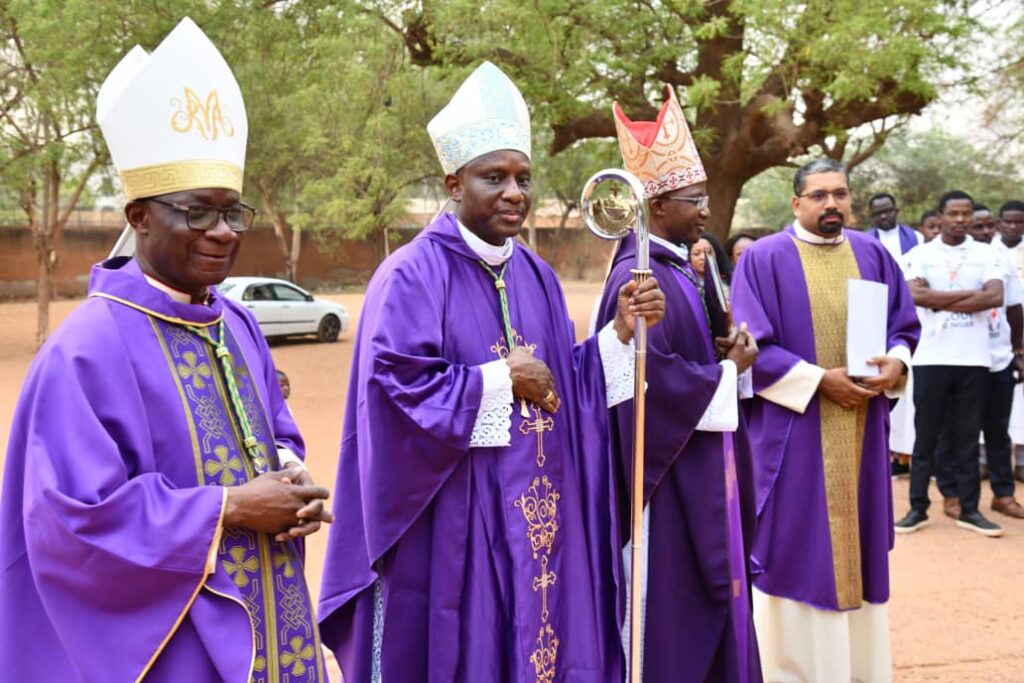
Niamey, Niger — Ce fut un moment de joie et d’accueil chaleureux lorsque Son Excellence, Mgr Éric Suiviguidi, nonce apostolique pour le Burkina Faso et le Niger, a effectué une visite à Niamey du 22 au 25 mars afin de présenter ses lettres de créance au président Abdourahamane Tiani. Lors de la messe qu’il a présidée le mardi 23 mars, le nonce a prononcé une homélie marquée par le paradoxe entre le choix humain et la miséricorde divine. \”Parfois, nous faisons des choix qui mènent à la mort, mais malgré cela, nous avons un Dieu dont la miséricorde dépasse nos choix de mort\”, a-t-il déclaré, rappelant aux fidèles l’amour constant de Dieu, même face à la fragilité humaine. “Même lorsque nos choix nous éloignent de Dieu, sa miséricorde ne cesse jamais de nous chercher” — Mgr Éric Suiviguidi Il a également médité sur la crucifixion du Christ, soulignant que Jésus appelle tous les hommes à Lui. \”Jésus n’est pas seulement la Parole de Dieu, mais Dieu Lui-même\”, a-t-il affirmé, insistant sur l’exigence de la foi : \”Soit vous croyez en Jésus, soit vous le rejetez. Il n’y a pas d’intermédiaire.\” Le nonce a encouragé les chrétiens à persévérer malgré les épreuves. Il a reconnu que l’Église au Niger traverse d’importants défis, mais a exhorté les fidèles à ne pas se laisser décourager. S’inspirant de l’histoire des Israélites, il a invité chacun à revenir vers Dieu par la repentance, en ayant confiance en sa guérison et en sa fidélité. Une mission au cœur du lien entre l’Église et l’État Après l’homélie, Mgr Laurent Lompo, archevêque métropolitain de Niamey, a remercié le nonce pour sa visite. Il a rappelé que le nonce représente une « double mission » : Celle du Saint-Siège auprès de l’Église locale, mais aussi auprès de l’État nigérien. Il a également salué la présence de Mgr Ignatius Anipu, évêque de Maradi, ainsi que celle des nombreux fidèles venus accueillir le représentant du pape. Éclairage canonique sur la visite du nonce L’abbé Wilfred Agbanglanon, canoniste diocésain, a expliqué que la présentation des lettres de créance constitue une étape essentielle dans la mission d’un nonce apostolique. \”Lorsqu’un nonce est nommé, il doit présenter ses lettres de créance avant d’exercer officiellement sa mission. Cela établit un lien officiel entre le Saint-Siège, l’État et l’Église locale\”, a-t-il précisé. Selon lui, ce cadre permet à l’Église d’être reconnue juridiquement, d’exercer ses droits et de bénéficier d’une protection institutionnelle, tout en respectant les lois de l’État. La présence du nonce renforce ainsi ce lien diplomatique et pastoral. “Le nonce est le signe visible d’un lien vivant entre Rome, l’Église locale et la nation. ” — Abbé Wilfred Agbanglanon Réactions pastorales et témoignages Pour de nombreux fidèles, cette visite a été une source de consolation et d’espérance. David Sagnan, venu de la région de Makalondi, zone fortement touchée par l’insécurité, témoigne : \”C’est une visite très importante pour nous. Le fait que le nonce vienne jusqu’à nous, au nom du Saint-Père, nous donne du courage. Les fidèles dispersés se sentent soutenus. Cela nous rassure profondément.\” Le père Flavian Akpo, curé de la paroisse Saint Augustin de Bobiel, voit dans cette visite \”Une véritable manifestation de la proximité de l’Église\”. \”Cela montre que nous ne sommes pas abandonnés. L’Église reste proche et porte ses fidèles dans la prière\”, a-t-il ajouté. Pour sœur Anastasie, religieuse de Notre-Dame du Perpétuel Secours et directrice de l’École Canada Garçons, cette rencontre est une grâce particulière : \”C’est la première fois que je rencontre un nonce en personne. C’est une grande joie d’échanger avec lui et de recevoir ses conseils.\” Elle souligne également la dimension fraternelle de cette visite : \”C’est une bénédiction pour notre Église. Ce nonce est africain, c’est notre frère. Il nous promet sa proximité, ses prières et sa collaboration.\” Sur le terrain : une atmosphère de joie et d’hospitalité Au-delà des moments officiels, la visite s’est aussi vécue dans la simplicité des rencontres : salutations, échanges spontanés, discussions entre prêtres, religieux et fidèles. Dans ces moments de proximité s’est manifestée une Église vivante, fraternelle et solidaire. “Dans un contexte d’épreuve, la présence de l’Église devient un signe concret d’espérance. ” — Augustine Anwuchie Une visite pas comme les autres Dans un contexte marqué par l’insécurité et l’incertitude, la visite du nonce apostolique apparaît comme un signe fort : celui d’une Église qui ne se retire pas, mais qui s’approche. Proximité du Saint-Siège, reconnaissance institutionnelle et encouragement pastoral convergent vers une même réalité : une espérance fragile, mais bien vivante.

\”La miséricorde de Dieu dépasse même nos choix de mort\”, affirme le nonce à Niamey Read More »

Judas Iscariot: Betrayer, Catalyst, or Mirror of Ourselves?

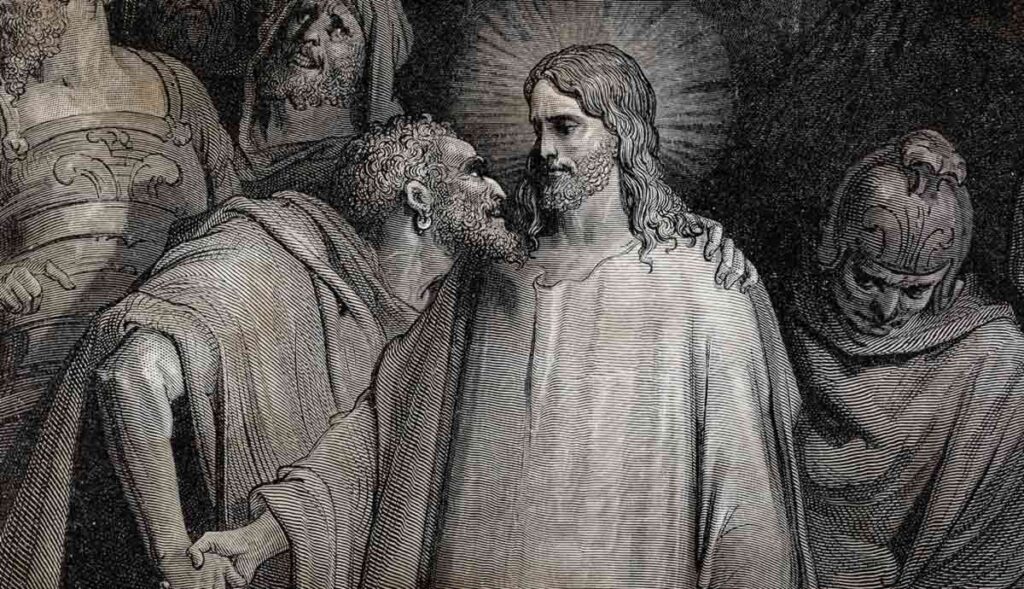
The Shadow in the Garden It was night in Gethsemane. The olive trees stood still, like silent witnesses. The stars, veiled by heavy clouds, withheld their light. In that darkness, a man kissed another man—a gesture of friendship turned into betrayal. The man who received this kiss had just fed Judas a morsel of bread dipped in rich soup—an act of love, honour, and intimacy—even as he knew Judas was already entangled in greed and deceit. That kiss has echoed through the centuries, forever tied to the name Judas Iscariot. To most of Christendom, Judas is the villain of the Passion narrative—the apostle who sold his teacher for thirty pieces of silver, the one who, realizing the weight of his crime, threw the money into the temple and hanged himself in shame. “It would have been better for that man if he had never been born” (Mark 14:21), Jesus said—words that have shaped how generations remember him. But is this the whole story? “Judas is not only the betrayer we condemn—he is the mirror we avoid.” — Augustine Anwuchie The Gospel of Judas In the canonical Gospels, Judas is portrayed in a grim light. He is the outsider among the twelve, the keeper of the moneybag, who—driven by greed or perhaps disillusionment—facilitated the arrest that led to the crucifixion. The traditional Christian understanding is clear: Judas failed not only in betrayal but in despair. Peter denied Jesus, too—but he wept, repented, and returned. Judas despaired and was lost. Yet a question remains: why did Jesus choose him in the first place? Could divine foreknowledge have overlooked Judas’s future? Or was he chosen because he would do the unthinkable? A Saint in the Shadows? Reframing Judas Among the most controversial interpretations in theological history is the idea that Judas may have been a necessary agent in the story of salvation. This view appears in certain Gnostic traditions, particularly in the Gospel of Judas, a 2nd-century Coptic text rediscovered in modern times. There, Judas is not a villain but the disciple who truly understood Jesus. Jesus tells him: “You will exceed all of them. For you will sacrifice the man that clothes me.” (Gospel of Judas, pp. 56–57) In this account, Judas’s act is not treachery but obedience—he alone carries the burden of initiating the events that lead to the cross. Without Judas, there is no crucifixion; without the cross, no resurrection. The Church, however, has never accepted this interpretation, maintaining that Judas acted in freedom and bears responsibility for his betrayal. Still, the question lingers: Could Judas have been the necessary shadow—the one through whom redemption unfolded? “Without Judas, there is no cross; and without the cross, there is no resurrection.” — Augustine Anwuchie Literature’s Reckoning with the Traitor Writers and thinkers have long wrestled with Judas’s legacy. Jorge Luis Borges, in Three Versions of Judas, imagines a theologian who argues that Judas was the true sacrifice—one who embraced eternal infamy as the ultimate act of self-denial. Nikos Kazantzakis, in The Last Temptation of Christ, portrays Judas not as a mere traitor but as a loyal friend who carries out a painful mission at Jesus’ request. These interpretations do not excuse Judas—but they complicate him. They force us to look again, not just at Judas, but at ourselves. The unsettling truth is this: Judas is not only a figure to judge. He is also a mirror. The Question of Betrayal We all betray—sometimes in small ways, sometimes in ways that wound deeply. We betray others, ourselves, and even what we claim to believe. Sometimes it is greed. Sometimes confusion. Sometimes fear. Sometimes a misguided sense of purpose. But the crucial difference is what happens next. Like Peter, we can repent and return. Or like Judas, we can let shame hollow us out until we no longer believe that mercy is possible. And when we are the ones betrayed, we face another choice: to remain trapped in bitterness—or to see even betrayal as part of a larger story, one that may yet lead to healing and renewal. The Unanswered Question Judas Iscariot remains a troubling figure—one we cannot fully explain or dismiss. His story refuses to stay in the past. It confronts us with the reality of freedom, sin, and grace. The question is not simply whether Judas was lost or redeemed. The deeper question is this: When we fall, do we still believe that mercy can reach us? Because in the end, the story of Judas is not only about betrayal. “The real question is not whether Judas was lost, but whether we still believe mercy can reach us when we fall.” — Augustine Anwuchie It is about the terrifying—and beautiful—possibility that even in our darkest moments, grace still waits.

Judas Iscariot: Betrayer, Catalyst, or Mirror of Ourselves? Read More »

PNFPB Install PWA using share icon

For IOS and IPAD browsers, Install PWA using add to home screen in ios safari browser or add to dock option in macos safari browser